Road Tripping Through Portugal: Massive Waves, and Sacred Shrines
We packed up our things and said goodbye to the Penha Longa Resort in Sintra. Our ultimate destination was Porto, but we weren’t taking the direct route. A road trip through Portugal meant exploring some incredible stops along the way.
Our travel crew included our friends Krystal and Titus, who were hiding in the back seat with all our road trip snacks. We were looking at about four or five hours of driving with some amazing stops planned.
Nazaré: Where Legendary Waves Meet Tradition
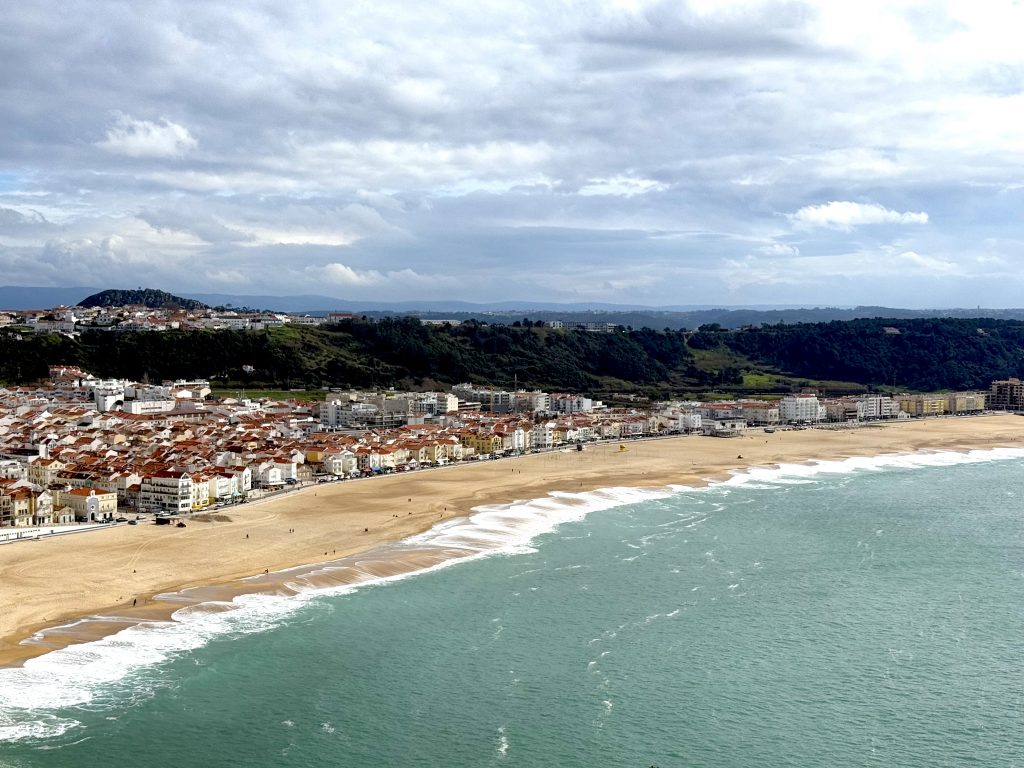
Our first destination was the coastal city of Nazaré, known for some of the most amazing waves in the ocean. This fishing village sits right on the Atlantic coast with plenty of beach access. People come here for beach time and surfing. This is where the largest wave ever surfed in Portugal was recorded.
Walking through town, we noticed lots of elderly people, making us think this might be a popular retirement spot. There were also tons of dogs wandering around. A funicular sits up on the hill, though it wasn’t running during our February visit in the low tourist season. A lighthouse perched on the cliff looked worth checking out.
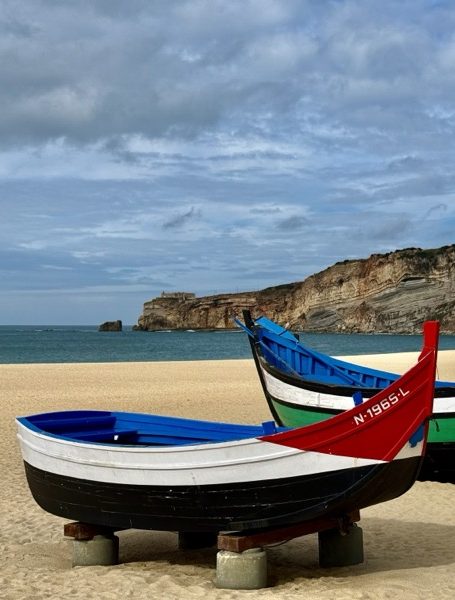
Near the water, we found traditional fishing boats on display. You can actually climb into at least one of them, which gives you a real sense of the local fishing heritage. The town is actually pretty big when you drive through it, but it has that charming seaside atmosphere.
While some of us headed down to put our feet in the Atlantic Ocean, we discovered the fish market area along the coastline. Rows and rows of fish were laid out drying in the sun, including lots of octopi. The smell was very pungent as you walked along the beach, but seeing this traditional method of preserving seafood was fascinating.
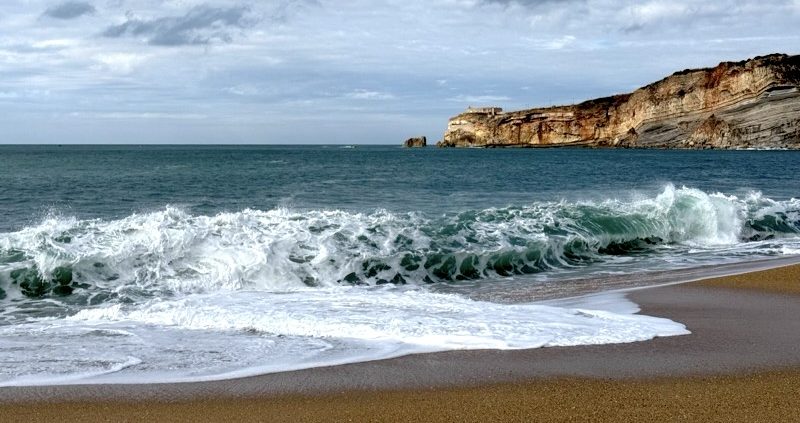
The waves at Nazaré are unlike anything we’d experienced before. They’re not steady and predictable. Some waves would roll in gently, then suddenly the next one would surge 20 or 30 feet higher than the last. It’s random and honestly a bit crazy. Krystal gave us fair warning to roll up our pants because these waves are unpredictable. Even with caution, the water still caught us off guard a few times. If you plan a casual stroll along this beach, just know you’re probably getting wet.
We drove up toward the lighthouse and were rewarded with incredible views. We had to park about half a mile away and walk down a closed road for about 10 minutes. Parking was free, though someone usually stands there asking for donations. We gave them a euro or two, and they watched our car, which we appreciated.
The lighthouse turned out to be more of a building than a traditional lighthouse structure. We stopped a few meters short to take in the stunning coastal views before heading back up the hill.
Since we were between cities and didn’t know what we’d find for lunch, we grabbed something quick at Burger King. That’s just what happens on road trips sometimes.
Fátima: A Massive Pilgrimage Site
Our second stop took us to the town of Fátima to visit the Shrine of Our Lady of Fátima. The story goes that the Virgin Mary appeared to three young shepherd children in 1917, which is why this has become a major pilgrimage site for Roman Catholics from around the world.
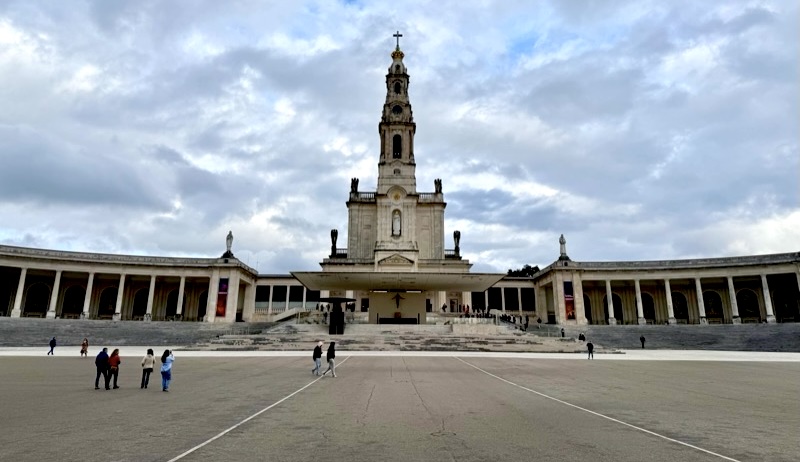
We weren’t entirely sure what to expect, but the facility is absolutely massive. The building we first encountered was the Basilica de Santíssima Trindade, which can seat over 9,000 people. When we peeked inside, the sheer size took our breath away. The building is fairly simple in design, but it’s executed beautifully and the scale is overwhelming.
Underneath the main grounds, they have several other areas where they typically hold mass, along with spaces for contemplation and prayer. There’s even a museum with exhibitions about the site’s history.
The main square is the actual shrine, and the entire outdoor area is set up to accommodate mass. We couldn’t believe this, but it can hold up to 300,000 people at one time. We thought 9,000 in the main basilica was impressive, but 300,000 outside is mind blowing.
One detail that stood out was the daily mass schedule. They offer several masses throughout the day in multiple languages. On the day we visited, masses were available in Portuguese, Italian, Arabic, Indonesian, and Korean. The international reach of this pilgrimage site really shows in those language offerings.
The church we visited houses the burial place of the three children to whom the Virgin Mary appeared. Francisco and Jacinta, a brother and sister, were told by Mary that they would be taken to heaven soon. They both died during the Spanish flu pandemic in 1919 and 1920. Mary also appeared to their cousin Lucia, telling her she would live a very long life. Lucia devoted her life to God and became a nun. She lived until 2007 and was canonized as a saint by Pope Benedict XVI in 2008.
The scale and devotion present at Fátima made it one of the most impressive religious sites we’ve ever visited, regardless of your personal faith.
After leaving Fátima, we drove about two hours north to Porto. Between our time in Nazaré and Fátima, we realized we’d spent more of the day exploring than we planned. We still had the two-hour drive ahead of us, and a lot of potential stops along the way would be closed by the time we arrived. We decided to drive straight through to Porto.
Our Portugal road trip had taken us from historic resort grounds to massive ocean waves to one of the world’s most important pilgrimage sites. Each stop revealed a different side of this incredible country; and Porto was waiting for us the next morning.
Want to see the incredible waves at Nazaré and the massive scale of Fátima’s shrine? Watch our Portugal road trip adventure on YouTube:


